
Leak detection in Vejle
A slope releases water on its own
Vejle is located in a river valley with steep sides, and on the slopes the water is high and moves downwards. Groundwater near the terrain emerges where a layer does not lead further, and drains under roads and gardens are led out where there is a drop. After a period of rain, a wet field can lie there for weeks without any pipe leaking.
And a leaky pipe up on a slope rarely shows up on the slope. The fall carries the water further before it becomes visible.
What the water in the slope comes from
Some signs can be read without equipment. A seepage that fluctuates with the weather and decreases during a dry period leans toward natural water. A flow that is equal in a dry summer and a wet November leans toward a pressurized pipe because the pressure does not follow the season.
The volume also matters. A loss in a supply line under full pressure runs at a fairly even output all day long, while drains and surface water follow the rainfall with a delay of days. If you have a meter well or a zone meter nearby, the night consumption during the same period can be read together with the leakage.
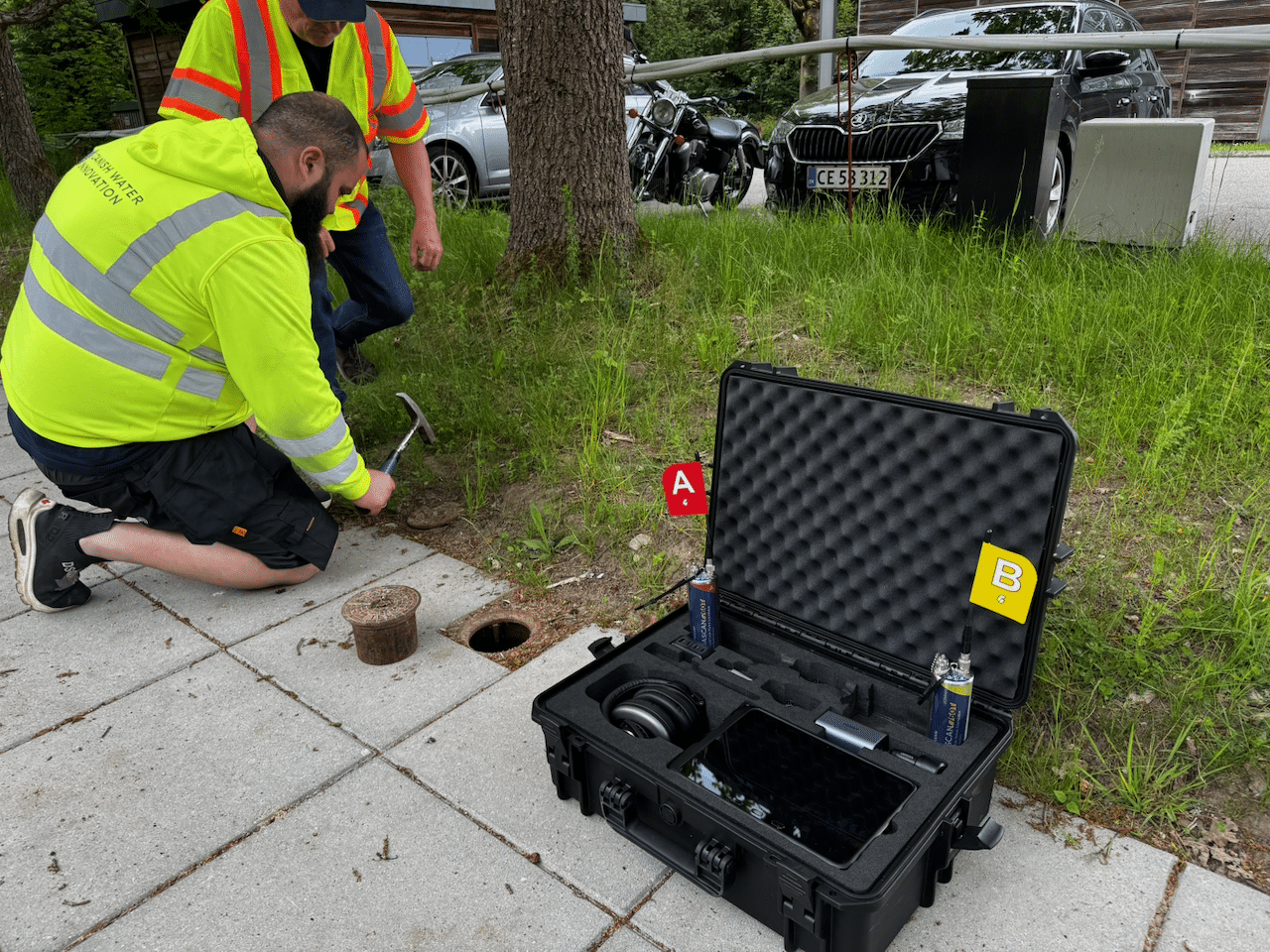
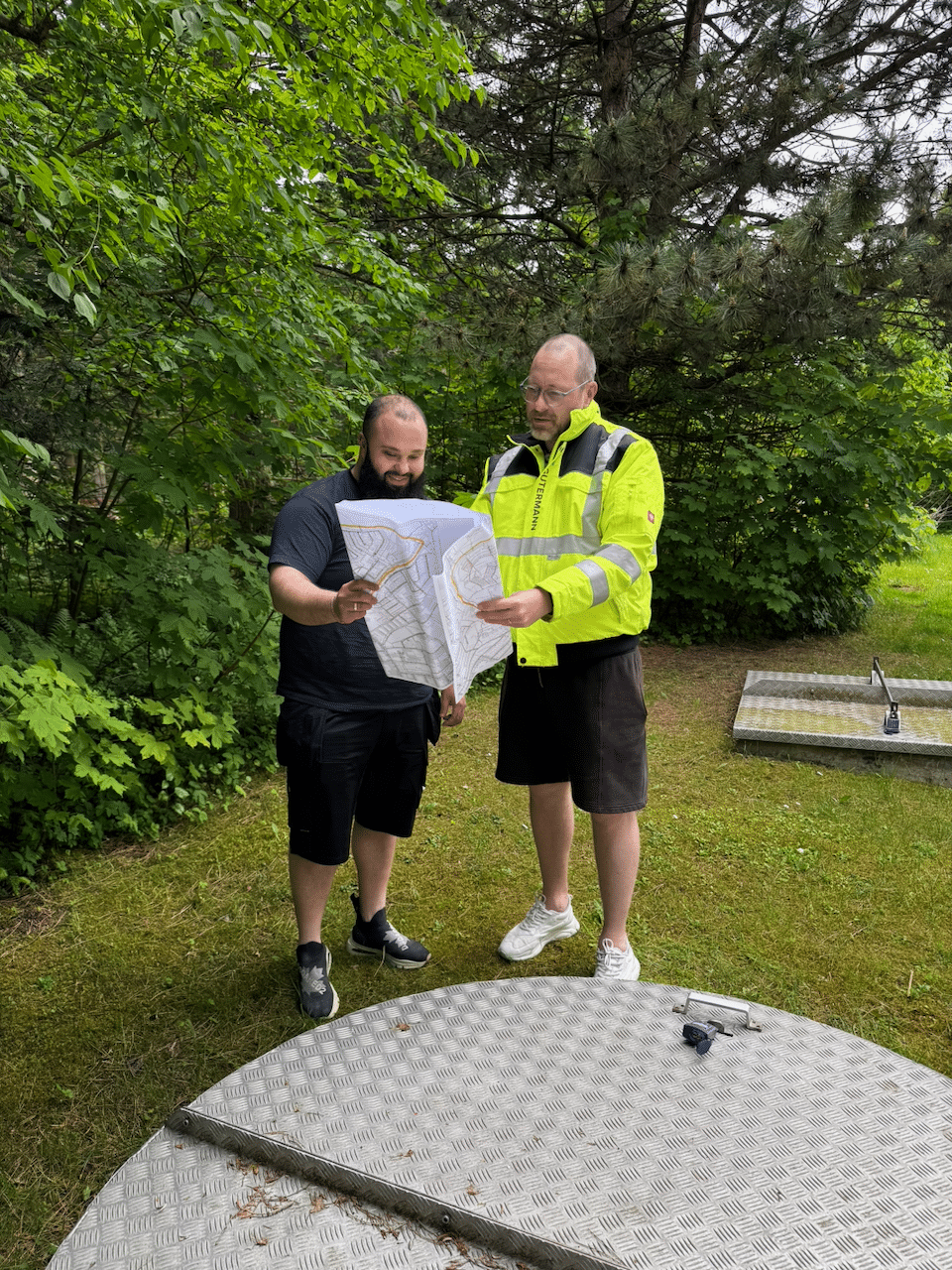
The fall moves the water before it shows itself
A trench is filled with sand and gravel, and it follows the road and terrain. On flat land, the water from a leak will be roughly where it comes out, and the wet patch will be close to the hole. On a slope, the trench fill is the most accessible path down, and the water will flow in it until something stops it.
Therefore, the visible point is rarely the excavation point. The water emerges where the slope breaks, where the excavation meets denser soil, where a road box lies across, or at a basement wall further down. The distance to the leak can be many meters, and the direction is only known if you know the course of the pipe.
The course of the pipe is therefore rarely something we assume. A pipe that is laid down a slope is often located in a different place than on the drawing because it was laid where the terrain allowed it at the time. Wire search determines the course of events, and only then is it possible to say which path is towards the leak.
So we work upwards. We start at the place where the water appears, follow the wire towards the fall and measure our way up the stretch until the signal turns.
Leak detection in Vejle on steep terrain
The height difference also sets the conditions for the measurement. Two measurement points on the same section may be several meters apart, and then the pressure at the two ends is not the same. This must be taken into account when assessing what is heard where, because the signal strength follows the pressure at the point and not in the zone as a whole.
Access is the second part. Wells and taps in a slope are located on the sides of roads and in areas that are not always easy to access with equipment, and a few of them are often hidden under vegetation. We review what is available on the route before we arrive, so the day is spent measuring. If there are no usable listening points, trace gas is the way forward because it does not require two points on the same pipe.
Measuring on a sloping stretch requires practice, precisely because the two ends are rarely at the same height and the readings cannot therefore be compared directly. If your own people are to be able to make that assessment, the DWI Leak Academy holds basic course in pipe and leak detection in Hørsholm.
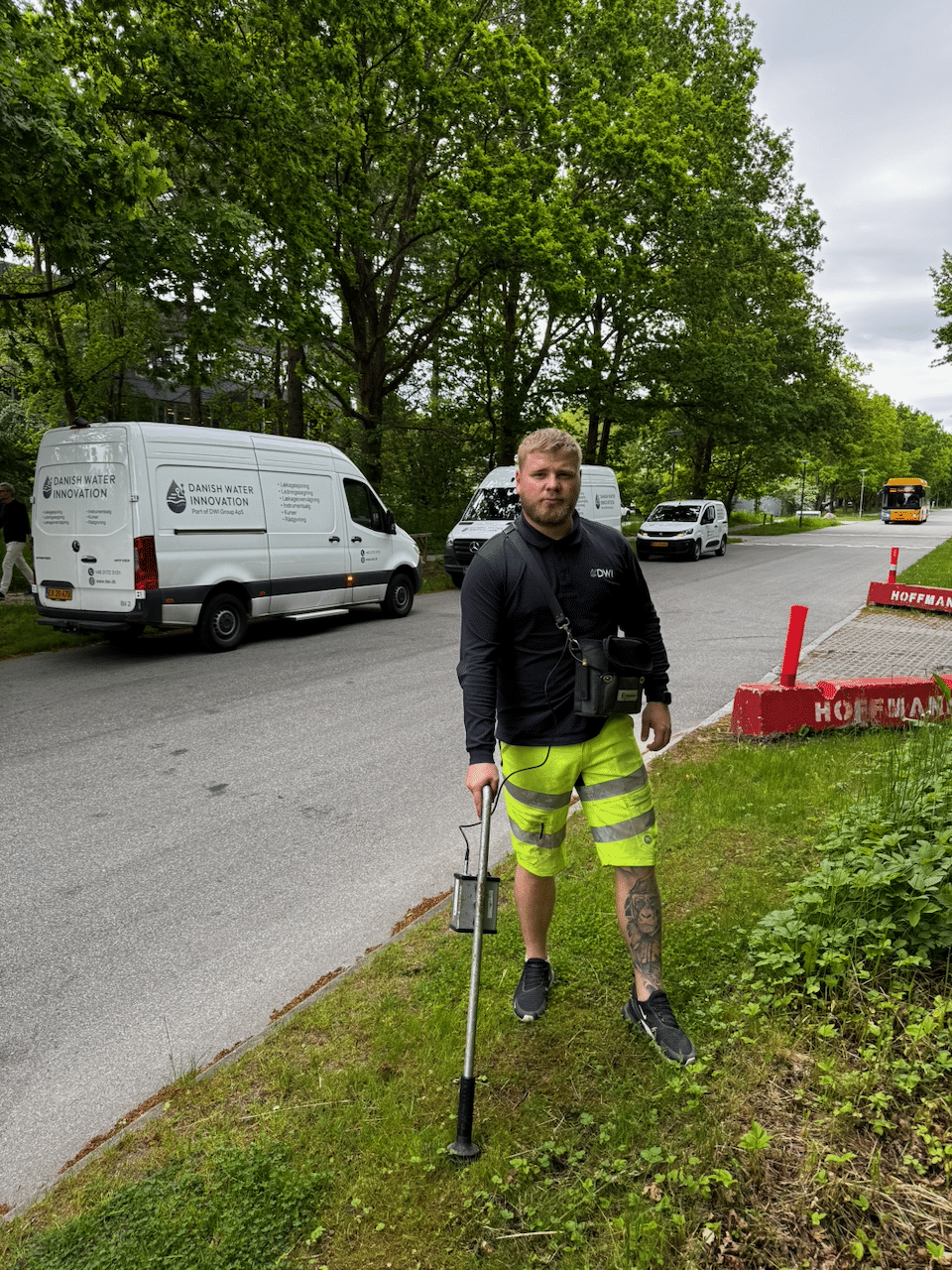
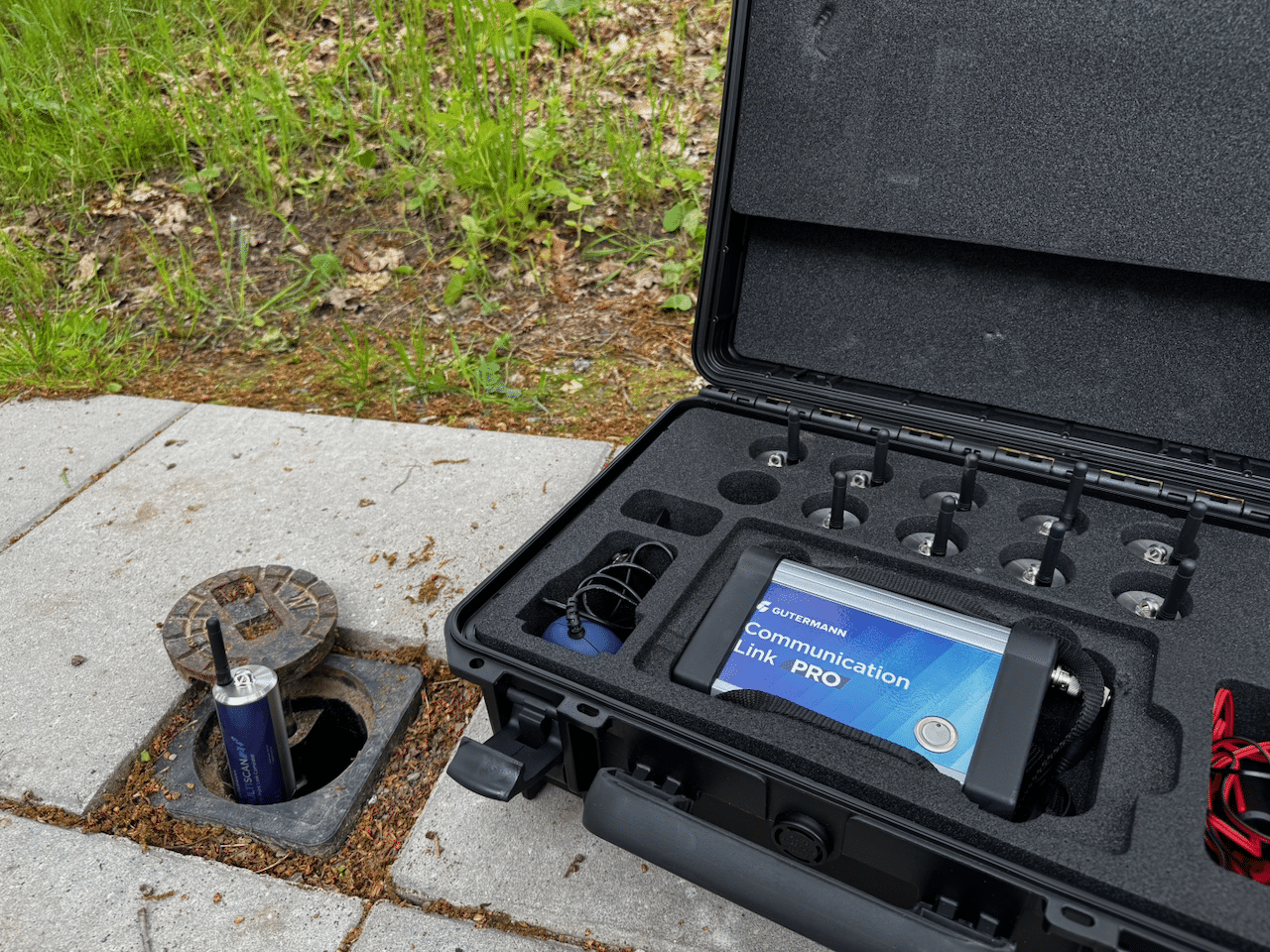
Leak detection in Vejle at the foot of a slope
Properties below a slope get water in from two directions. From the outside through the foundation and ground cover if drainage is not included, and from the inside through a leaky inlet or a joint under the floor. The two look the same on a damp basement floor.
The timing speaks for itself. If the moisture only comes after heavy rain, it speaks for terrain and drainage. If it is the same in March and in August, it leans towards the installation, and that is what we measure first.
We measure the water installation and the plug in the field. If there is a leak, we mark it, and your plumbers dig and repair it — DWI does not dig itself. If the water pipe can be ruled out, it is stated in writing, and then the building's drainage and the terrain around it must be looked at. If it is urgent, you can call the emergency number +45 70 23 98 98 and often get an operator out the same day.
Yes, and it is common. The fill in the pipe trench directs the water downward, so the leak can be many meters from the hole. We follow the pipe up the slope instead of measuring where the water is.
A documented exclusion of the water main with measurement points and method in writing. From there, the case can proceed to drains or to natural water, without anyone having dug on a guess.
It may be, but infiltration from the outside is just as common in that situation. We measure the inlet and outlet first because that is one of the two possibilities that can be determined with equipment.
Yes. We note the height difference between the points because the pressure and thus the signal strength is not the same at the two ends. This changes how a weak reading should be read, but not whether the distance can be measured.
It depends on what is in the ground. If there is a road drain or stormwater pipe nearby, it falls under the municipality or the owner of the pipe; if it is the building's own drainage, it is a sewer master. Our documentation is included with them.
Contact DWI
Contact us for competent advice, leak detection and pipe location for your waterworks or water supply. We also assist commercial customers and private households with professional solutions.
